From baskets of termite mushrooms to trays of boletes, Yunnan’s rainy season changes what appears in markets and kitchens across the province. Here is what visitors should know before ordering, buying, or joining a market visit.
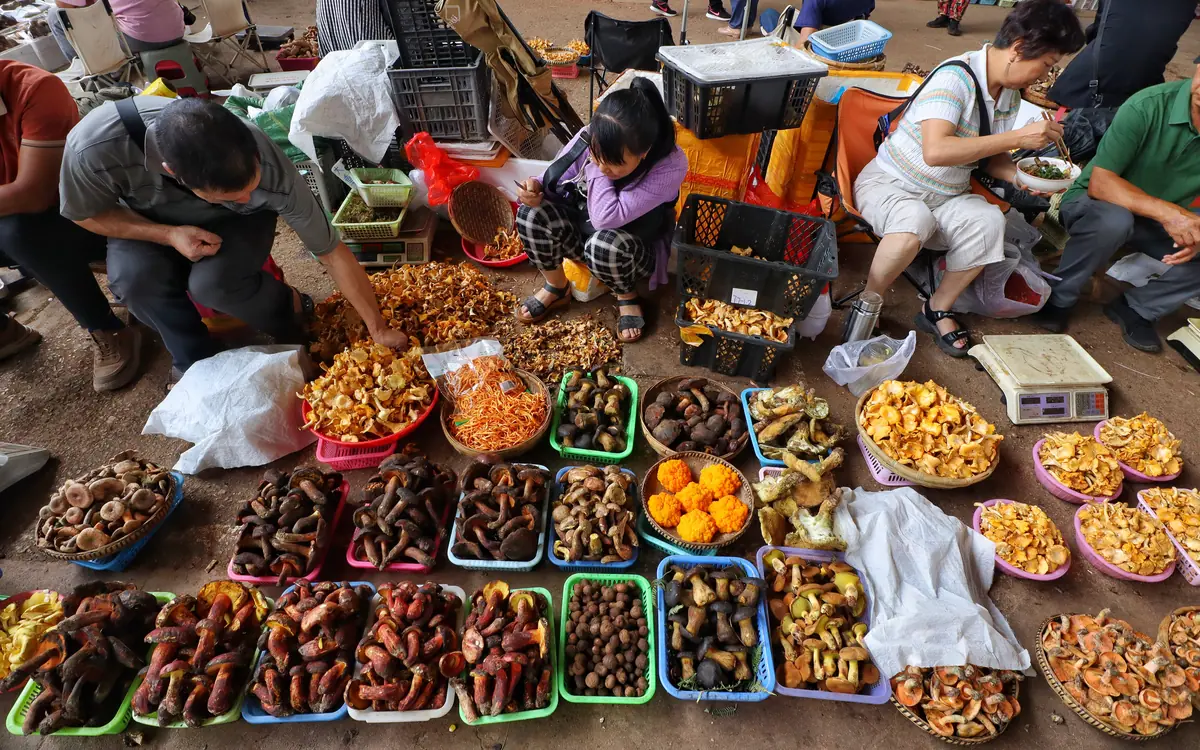
When the summer rains arrive in Yunnan, wild mushrooms begin appearing in forest soil and market baskets. The season is visible in ordinary routines. Vendors sort mushrooms by type and condition, restaurant menus change, and cooks adjust each dish to the mushroom in front of them.
Yunnan has exceptional fungal diversity, but the exact totals vary between surveys and sources. Hundreds of edible species have been recorded in the province, while a smaller number are traded regularly. For a visitor, learning every name is less useful than understanding the season, recognising a few major groups, and knowing why local knowledge and careful cooking matter.
When is wild mushroom season in Yunnan?
The main season usually follows the summer rains, broadly from June to October. This is a general window rather than a fixed calendar. Rainfall, temperature, altitude, and forest type all affect when mushrooms appear, and some species may be available for only a few weeks.
Markets can change noticeably through the season. Early arrivals give way to a wider selection after sustained rain, while later varieties appear as the weather begins to cool. Availability also differs across the province. Northwest Yunnan is strongly associated with matsutake and morels, while central and southern areas are known for a broader mix of boletes, termite mushrooms, chanterelles, milk-caps, and other local varieties.
Timing varies with rainfall, altitude, temperature, and forest type.
Wild mushrooms visitors may encounter
Market names do not always match a single scientific species. One local name may cover several related mushrooms, and the same mushroom may have different names in different places. The examples below are useful groups to recognise, not an identification guide.
Matsutake
Matsutake is one of Yunnan’s best-known wild mushrooms. It grows in association with forest trees and cannot be produced like an ordinary cultivated mushroom. The main season is usually July to September, and northwest Yunnan, especially Diqing Prefecture, is an important producing area. Its firm texture and distinctive aroma suit simple preparations that do not bury the flavour.
Ganbajun
Ganbajun has a dense, branching form and a dry, fibrous texture. It grows around particular pine species and is among Yunnan’s more expensive wild mushrooms. Cleaning it takes time because soil and pine needles become caught between the folds. It is often cooked simply so its strong aroma remains clear.
Termite mushrooms
Termite mushrooms grow through a close relationship with termite colonies. The termites maintain fungal gardens inside their nests, and the mushrooms send up fruiting bodies when conditions are right. Their long, tapering underground stems are one clue used by experienced collectors, but visitors should not try to identify them independently. In Yunnan kitchens they may be stir-fried, cooked in soup, or fried and preserved in oil for use after the fresh season ends.
Boletes
Boletes form a large family of mushrooms with pores under the cap rather than gills. Yunnan markets often separate them by colour and local type. The English word “bolete” is more accurate for this broad group than “porcini”, which refers to a narrower set of species.
Some locally prized boletes stain blue or green when cut or bruised. Several require thorough cooking, and undercooked specimens have been linked to serious poisoning, including neurological symptoms and hallucinations. A blue colour change alone does not tell a visitor whether a mushroom is safe.
Morels
Morels have a honeycomb-like cap and are associated with parts of northwest Yunnan, including Lijiang and Diqing.
Chanterelles and milk-caps
Chanterelles are recognised in markets by their yellow to orange colour and folded ridges beneath the cap. Milk-caps release a milky liquid when cut, although the colour and amount vary between species. Both groups include mushrooms sold widely in season, but a market label should not be treated as proof of identity.
Bamboo fungus
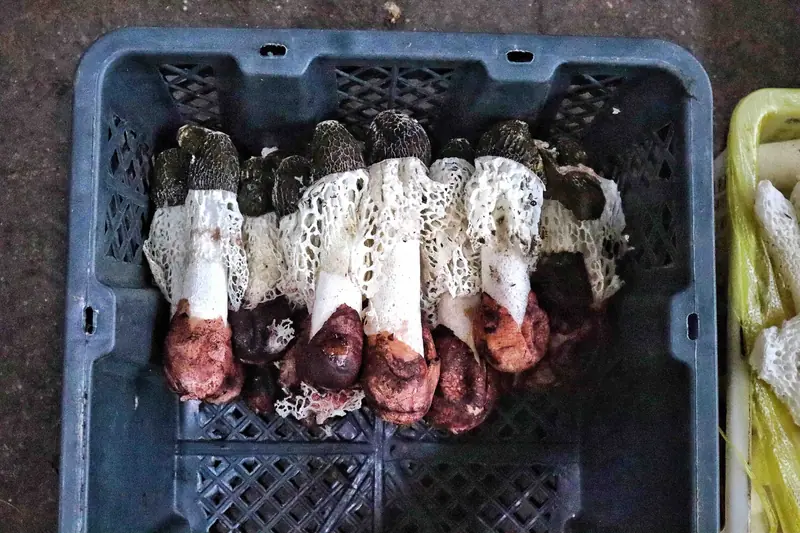
Bamboo fungus has a delicate net-like skirt and occurs in several parts of the province.
Yunnan truffles
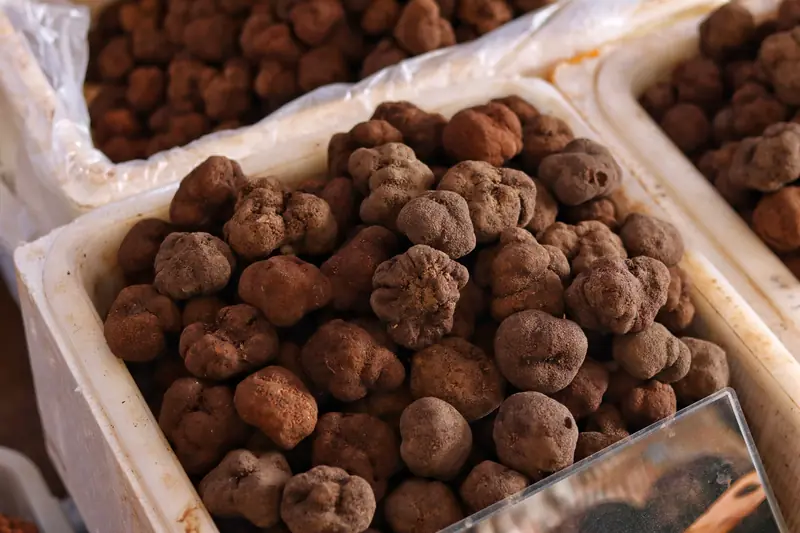
Yunnan produces native truffles, including dark and pale species that grow underground in association with tree roots.
How mushrooms move from forest to table
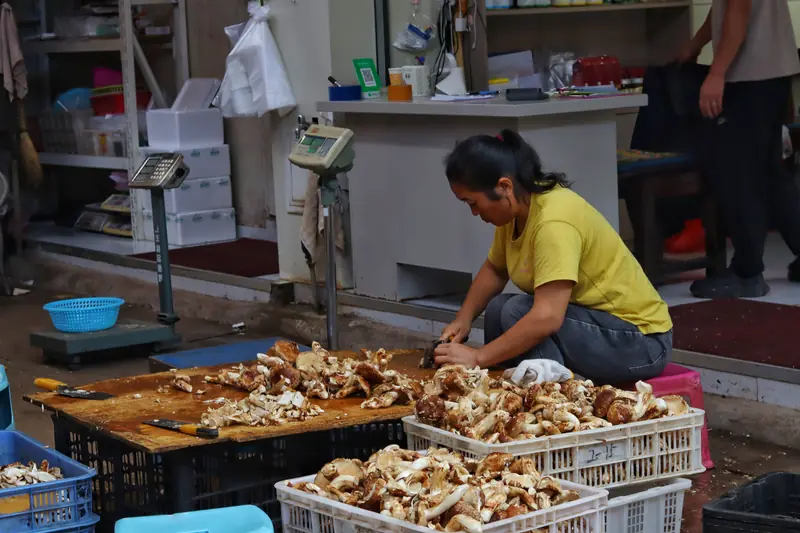
Fresh wild mushrooms are highly seasonal and perishable. Collectors bring them to village buying points and local markets, where they are sorted by species, size, condition, and intended use. Some continue to restaurants or larger wholesale markets. Others are dried, pickled, or cooked in oil so they can be eaten beyond the rainy season.
Price alone does not tell the whole story. A mushroom may cost more because it is scarce, has a short season, is difficult to clean, or must travel quickly after harvest. Everyday varieties are just as useful for understanding how people cook at home. Market visits are often most interesting when the conversation moves beyond the most expensive basket.
What to look for at a Yunnan mushroom market
Seasonal changeAsk what has just started appearing and which mushrooms are close to the end of their season.
Sorting and cleaningNotice how vendors separate species and remove damaged pieces, soil, leaves, and pine needles.
Local namesTreat names as market knowledge rather than universal scientific labels. The same term may cover more than one species.
Cooking adviceIf you buy mushrooms, ask an experienced vendor or cook how that exact batch should be cleaned and cooked. Do not transfer advice from one type to another.
Wild mushroom safety in Yunnan
Important safety note
Never use an article, photograph, app, or market label as the sole basis for deciding whether a wild mushroom is edible. Some poisonous species resemble edible ones, and some mushrooms considered edible can still cause poisoning if they are confused, stored badly, or undercooked.
Eat wild mushrooms only when they have been identified and prepared by people with reliable local experience. Do not mix unknown species, do not eat specimens that seem spoiled, and seek medical help promptly if symptoms appear after a meal.
Yunnan is one of China’s main areas for wild mushroom poisoning, with cases concentrated in the rainy season. The risk is not limited to dramatic-looking mushrooms. In rural Yunnan, researchers traced a cluster of unexplained sudden deaths to a small toxic mushroom that had been eaten locally. Public warnings and changes in eating practices sharply reduced the deaths after the cause was identified.
The practical lesson is simple: local familiarity does not remove risk, and a visitor should never turn a market visit into an unsupervised foraging exercise.
Experiencing mushroom season responsibly
A good mushroom-season visit focuses on how people identify, sort, sell, preserve, and cook what is available that day. A local market and a carefully chosen meal can explain far more than a long species checklist. Forest access also needs care. Collecting may be restricted, and careless harvesting can damage the underground fungal network and the habitat around it.
Yunnan Eco Tours can include a market visit, seasonal mushroom meal, or guided foraging experience in a custom itinerary when local conditions and the route make it appropriate. Foraging is arranged with local villagers who know where to look and which mushrooms to pick. We do not encourage visitors to collect or identify wild mushrooms on their own.
Plan a route around your dates and interests
Tell us when you are visiting and what you would like to experience.
Contact Yunnan Eco Tours